Showing posts with label forage. Show all posts

Saturday, March 12, 2022

A Sweet Surprise

Life on Farm Dover continues to amaze me, even after nearly a dozen years of living here. There is always something happening in the gardens, fields or woods that fascinates me. This past week it was the startling discovery that we could tap our black walnut trees (of which we have plenty) for sap, that could then be boiled down to a most-delicious sweet syrup. 
If you read this blog with any regularity, you know that I love to forage for wild foods and, while I never claim that I can feed us on them exclusively, I do appreciate knowing that I can walk out the back door with a bucket and come home most days with ingredients for a very local, very fresh dinner. The addition of syrup has added a whole new basic taste (sweet) that I can cook with, adding panache to pancakes and waffles, oatmeal and sweet salad dressings. Yes, I know honey, fruits and berries are also sweet, but not like this syrup: complex and butterscotchy.

It all started with reading a blog entry from Practical Self Reliance covering 27 trees to tap for syrup. I was amazed that all kinds of hardwood trees could be tapped. The more I learn about trees, the more in awe I am of them. 

I suppose I always knew that sap flows through sapwood, part of the outer tree trunk, delivering water, sugars, and nutrients throughout the tree. But I'm not sure I understood that sap production actually begins in warm summer months when photosynthesis creates carbohydrates that get stored in the tree as starch. It then gets converted to sugar that dissolves into the sap, which is stored for the winter. Beginning in late winter, the weather provides just the right conditions (alternating freeze/thaw cycles) to produce sap that can be collected to make syrup.  

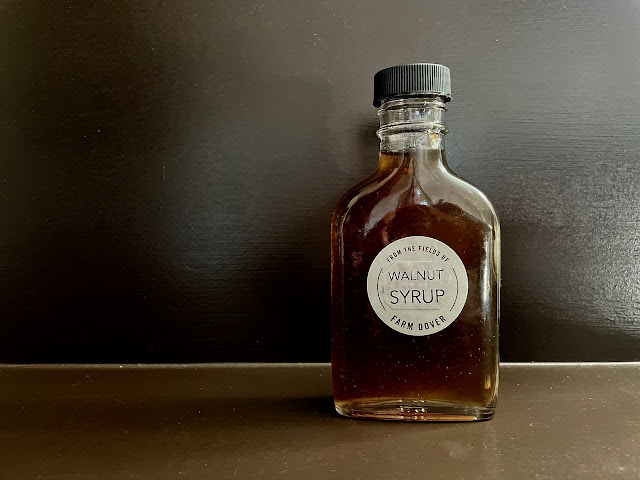
With some quick Googles, we were on a roll, figuring out how to harvest about 8 quarts of sap, resulting in one, very precious, bottle of syrup. 

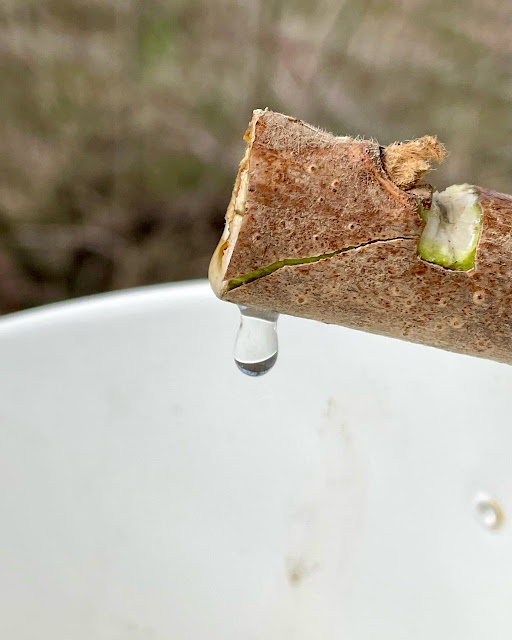
Because we didn't have any tapping supplies on hand, we made do. I carved spigots (also called spiles) from elder and sumac trees, hollowing them out with metal prods. 
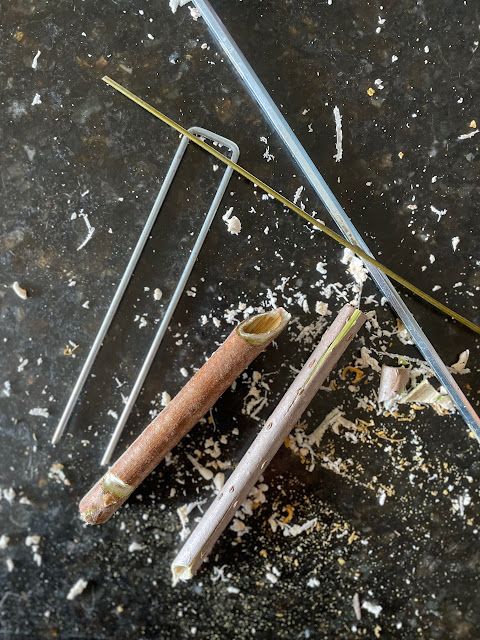
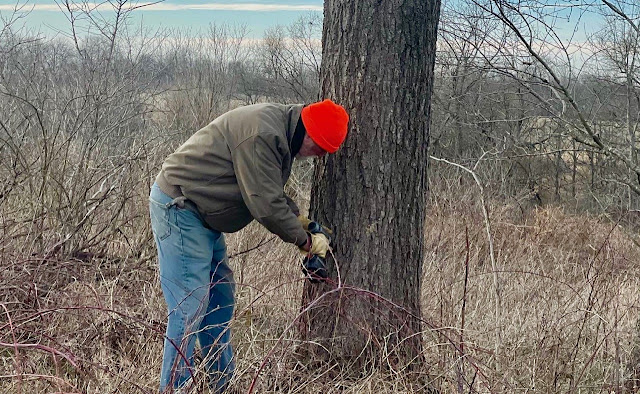


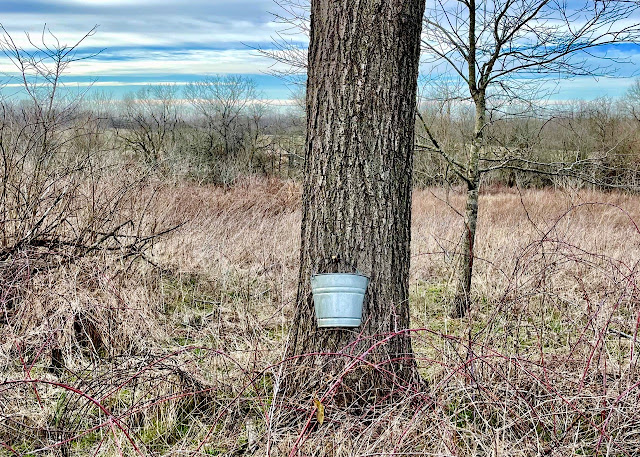
Ed drilled a hole in the first tree, on the south side to take advantage of the warming sun and hung a metal bucket from a notch carved in the spile. 


And as we turned to go to the next tree, we heard: drip. drip. drop. The sap was starting to flow and the bucket filled up in just a few hours. Back at the house, we poured ourselves a glass of the sap, which is sometimes taken as a spring tonic. It was cold and fresh, and only slightly sweet. It tasted as I imagine water would taste from a mountain spring -- invigorating!


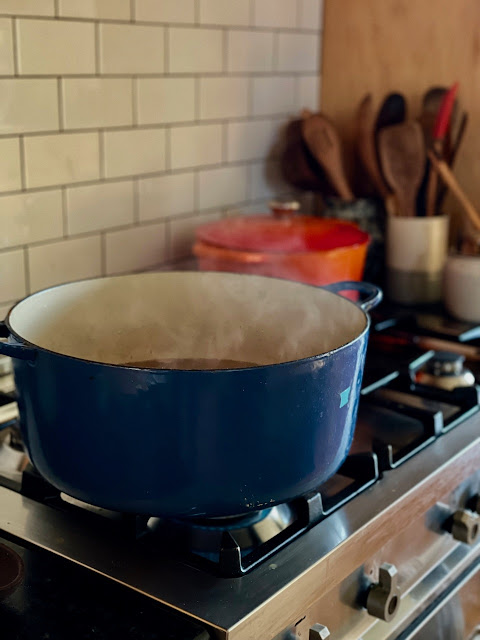
Once we had a pot full of sap, we boiled it down. It took most of the day and didn't really taste sweet until it condensed down to about a cup for every 30 or so cups of sap. Once done, and still warm, we poured it into a clean bottle and now it sits, just waiting for Hazel and Norbert to come for a pancake breakfast.*

* I did use the very last drips to flavor a bowl of oatmeal and it was spectacular. 


Next week looks like it will warm up and sap collection will surely fall off. But late next winter, we'll be ready and can hopefully bottle more than one flask of this precious elixir. 


Monday, December 6, 2021

Making a Better Bitters

Last December, Friend Alisa gave me a small book that she suspected I would like. I do, very much. Called Blotto Botany, written and illustrated by Spencre L.R. McGowan, it offers lessons in making cordials and other plant magic. Between its covers, there are dozens of recipes for cordials, and chapters on producing shrubs, bitters, and herbal medicinal remedies. 

Taking a page out of this book, I recently bottled up my latest foraging experiment: bitters. (And no, for the record, I did not get blotto.)

After researching bitters and how to use them – both in cocktails and as a digestive aid – I set out to create my own version using burdock root from our fields, berries from our spice berry bushes and fennel seed from my herb garden. Loosely based on this recipe from David Lebowitz, I added orange peel, a cinnamon stick and gentian root. I covered the ingredients in Everclear alcohol and waited three weeks, shaking the jar daily. Then, I transferred the finished tincture to small eyedropper bottles. 

Sunday evening, Ed and I did a taste test between our homemade bitters and two others that we just happen to have in our liquor cabinet: Fee Brothers Orange Bitters and the classic Angostura Aromatic Bitters. Not to brag, but we were both impressed by how well the Farm Dover version stood up to these industry standards. Ours tasted like tropical oranges with spicy overtones. The Fee Brothers was much more floral; the Angostura, more herbal. 


According to this article in Wine Magazine, you can think of bitters as the salt and pepper of a cocktail. One or two dashes can drastically change the flavor profile of a drink. Something magical happens when you add bitters to a Manhattan, Martini, Old Fashioned, Negroni (or any number of other cocktails): the nuances of flavor bloom and the cocktail tastes slightly drier, more balanced, and complex. 

You can also use bitters as a digestive aid, letting a few drops sit on your tongue before or immediately after a meal to improve gallbladder and liver functions. Alternatively, a dropper full can be added to sparkling water for a barely alcoholic beverage.

Whether we end up using our bitters to augment the flavor of our favorite cocktails or simply for their health benefits, it was easy to make our own version. Cheers to a delicious cocktail and to good health! 


Friday, August 28, 2020

Making Wine with Green Walnuts

I can often be found in the kitchen brewing up an assortment of strange foraged concoctions such as milkweed or elderflower cordials, elderberry gin, blackberry syrup or various herb vinegars. Ed joined me recently, taking the lead on the latest libation: vin de noix, otherwise known as green walnut wine. 

He was inspired by the main character in a detective novel. Bruno is chief of police in a small village in the south of France. He lives in a restored shepherd's cottage, shops at the local market, and makes his own vin de noix. What? Makes his own what? 

Turns out vin de noix is a home decoction obtained by macerating green walnuts in wine and vodka for 40 days and then bottling it and waiting until December 1 to partake. Known since the sixteenth century for its therapeutic qualities, today it is consumed as an aperitif or digestif. Sounds like our cup of tea!

The one thing we have plenty of at Farm Dover is walnuts. We've planted a field of 100+ black walnut trees and there are hundreds (maybe thousands!) of native ones growing all over the farm. The walnuts for this recipe need to be picked while they are still green and milky with very tender kernals. In France, the green nuts are traditionally picked on the Fete de la Saint-Jean-Baptiste, celebrated on June 24. 

So Ed picked the green walnuts back in late June and set to making the liqueur. For the past 40 days, the inky black infusion has been stored in a dark cabinet in our laundry room. Every couple of days, we'd give it a stir. 

Turns out versions of this drink are produced throughout Europe. Italy has a walnut liquor called nocino, made with alcohol, but no wine.  And Jack's girlfriend Kasia sent me a secret recipe from her grandfather in Poland who makes a vodka-based version, that includes caramel. Next June we will put it to the taste test.

Back to our walnut wine experiment... Last week, Ed strained the walnuts out of the liquor and bottled it. Stay tuned for the uncorking on December 1. It is recommended that it be served ice cold with a mandelbrot, biscotti or buttery cookie. Especially nice in front of a crackling fire. Sounds tasty, doesn't it?


Vin de Noix
Makes 6 liters

recipe from Cathy Barrow

40 young, green walnuts
1 liter vodka
5 bottles of red wine 
2 pounds sugar
Zest of 1 orange
Quartered lemon
4 cloves
1 vanilla bean, split

Gather the walnuts in late June when the nuts are well formed, but can still be pierced with a needle. Soak the nuts in cool water for 1  hour.  Drain, dry and quarter.

Place all of the ingredients in an non-reactive container with a lid.  Stir well to begin to dissolve the sugar. 

Store in a cool dark place for 40 days, stirring occasionally.

Strain through cheesecloth into a very large non-reactive bowl or food-safe bucket. Taste, and adjust the sugar if you want the drink to be sweeter. It will be a little harsh tasting, but will mellow as it ages.

Funnel the wine into quart jars. Store in a cool dark place until December 1st.


Wednesday, July 29, 2020

Seeking Marital Bliss

It's a good thing Ed and I get along, or this 130+ days of sheltering in place would get even older than it is getting. We rarely quarrel, but I must confess that there is one thing that we can't seem to agree on. And it's causing angst in our marriage.


The problem is: I love a good fruit crisp. One with lots of fruit and a fairly thick layer of crunchy oats, brown sugar, and almonds, bound together with some butter. One like the one found on page 689 of Deborah Madison's Vegetarian Cooking for Everyone.


I love to make crisps with the gallons and gallons of wild blackberries that we pick each July. And every time I make one and bring it to the table. Ed says: "This is good, but some people prefer a cobbler." He is one of them; I am not.


What was wrong with him? I continued to make crisps. 


But then I started to wonder if perhaps he was right and that maybe I could learn to love a good cobbler. Was I just being stubborn? So I turned to page 691 of the above-mentioned cookbook and made a cobbler. Ed was thrilled; me less so. I just don't like the cakey topping.


I then conducted a survey. I asked Jack which he preferred, secretly trying to line the kids up on my side. Without hesitation, he said, "I prefer a pie."

And that got me to thinking. Perhaps the solution for our impasse was to find a solution we could both agree on. So, today I made a clafoutis, a 19th-century french dessert that traditionally uses black cherries. My version featured Farm Dover wild blackberries nestled in a thick flan-like batter. (Technically, when other kinds of fruit are used instead of cherries, the dish is properly call a flaugnarde.) It was super simple to make.

I'm planning to serve it tonight, but snuck a bite out of the skillet while it was still warm. Not as good, in my opinion as a crisp, but much better than a cobbler. I think it might work for us and allow us to get back to our normal state of marital bliss.


If not, I could always try a Brown Betty, a buckle, a grunt, hand pie, slump or pandowdy.  I'm willing to work on saving our marriage thru baking and Ed says he is willing to give it a go as well. Wish us luck.

____________________

Farm Dover Blackberry Clafoutis
(loosely based on recipe by David Lebovitz)

ingredients

Enough blackberries (or other berries) to cover the bottom of a 11-inch cast iron skillet or other similar sized shallow baking dish
3 large eggs
1/2 cup all-purpose flour
1 teaspoon vanilla extract
1/8 teaspoon almond extract (optional)
1/2 cup plus 3 tablespoons sugar
1 1/3 cup whole milk
Soften butter, for preparing the baking dish

procedure

1. Preheat the oven to 375ยบF. Smear a 2-quart shallow baking dish or cast-iron skillet liberally with butter. 

2. Lay blackberries in a single layer in the baking dish.

3. Using an immersion blender, mix the eggs, flour, vanilla and almond extracts, 1/2 cup sugar and milk together until smooth.

4. Pour the batter over the blackberries and sprinkle fruit and batter with 3 tablespoons of sugar.

5. Bake the clafoutis until the custard is just set; a knife polked in the center should emerge relatively clean. It will take about 45 minutes. 


Monday, September 24, 2018

Weekend Getaway

Two weekends ago Ed and I took a quick trip to the 20th Annual Pawpaw festival in Albany, Ohio. It was our first pawpaw festival, but I'm hoping it's not our last. It was great fun.


We left on Friday morning in time to spend the afternoon floating on a small lake in southeastern Ohio casting for bass. It's called belly boat fishing and requires nothing more than kicking your feet (with fins) to guide an inflatable "boat" to wherever you think the fish might be biting. I call it belly-laugh fishing as I found myself grinning the entire afternoon.


We spent Saturday morning wandering around the PawPaw festival, a gathering devoted to all things pawpaw: ice cream, beer, lectures, vendors, competitions, music, trivia, cooking demonstrations, and storytelling. It was Ed and me, and hundreds of other pawpaw aficionados.

m

We have a dozen or so pawpaw trees scattered around Farm Dover, but are always interested in learning more about this amazing native fruit that tastes like a custardy cross between a banana and mango. Only one of our trees has actually produced fruit, but we remain hopeful that most of the others are getting near fruit-bearing age (4 to 8 years). This year I found pawpaw fruit for sale at Rainbow Blossom and bought enough to make two batches of pawpaw ice cream.

If you haven't tasted a pawpaw, you are missing out on a delicious life experience. Keep your eyes peeled for pawpaw trees growing in the wild, plant some of your own (I've got seeds I can share), or head to the Ohio Pawpaw Festival next year, September 13-15.

Pawpaw ice cream
(from The Splendid Table)
________________________

ingredients

2 cups pawpaw pulp (or more, if you have it)
1 cup sugar
2 cups cream
2 cups milk

preparation

Combine the pawpaw and sugar. Stir in the cream and milk. Pour mixture into an ice cream maker and freeze according the manufacturer’s directions.


Sunday, June 17, 2018

Mamma Nature Scatters Her Gifts

With every season here at Farm Dover, my understanding of Mother Nature's gifts expands; and my heart swells with gratitude for her generosity. She scatters her gifts along our paths, creeks and meadows, challenging me to pay close attention to her offerings and to take only what is needed. Ed calls my foraging "free food" but I know that in exchange, we must be good stewards of all she offers.

Here's a look at what I've been foraging in the past few weeks...

This spring saw the beginnings of our slow, but steady, progress towards encouraging ramps to root along our creek bank. These wild leeks (Allium tricoccum) grow very slowly, taking up to four years to flower and reproduce. They make their appearance in early spring and we are careful to harvest only a few leaves at a time, leaving the bulbs to spread. We have tried (only somewhat successfully) planting ramp seeds and ramp sprouts, hoping to start other colonies along the creek's banks. Cooked into an omelet, or scattered in a risotto, they lend a pungent garlic taste that screams springtime.


On the opposite end of the scale of ease of grow-ability is burdock (Arctium lapa), which flourishes under the maple grove at the end of our driveway. It's the plant that bears burs; you know, the ones that stick to your pants and don't want to let go. In years past, we have harvested and roasted its root, which can be quite difficult to dig. This year we harvested stems, which I boiled and then baked in a bread-crumb covered casserole. They taste a bit like artichokes and will definitely be making a repeat appearance at our dinner table next spring.


Next up was the tender leaves of the tops of pokeweed (Phytolacca americana), which I boiled (twice) and turned into poke salat, an early spring green (especially good when I add a bit of bacon grease to the skillet).


Last week, I harvested 75 elderflower (Sambucus nigra) blossoms to make elderflower cordial, which is basically a floral lemonade concentrate that I bottle and freeze to enjoy all year round.


Just last week I harvested the green blossoms from common milkweed (Asclepias syriaca), which I turned into a pretty green soup. Don't worry about my depleting this favorite food for Monarchs; we have hundreds and hundreds of milkweed plants growing in our fields. I took only one or two green blossoms from a dozen or so plants.


My latest foraging venture entails getting up early before the sun heats the day up and heading out to pick wild black raspberries (Rubus occidentalis). These are different from the millions of wild blackberries that grow along our paths and in large patches in our fields. These berries grow on thin arching canes that bend back toward the ground, rerooting where they settle. The thimble-shaped berries are ready to harvest only when the berries turn a dark purplish black, usually two or three weeks before the blackberries are ready to pick. The berries are sweet and tart – tasting slightly different from the domestic raspberries that grow in my garden – but I like them just as much. I took a quart to Maggie today and hope to pick enough in the next couple of days to make jam -- assuming I don't eat them as fast as I can pick them.


While out picking wild raspberries this morning, I noticed that the chicory flowers (Cichorium intybus) are starting to bloom. They bloom only in the mornings; by lunchtime they have closed up. We have been known to make chicory coffee from their roasted roots. I've got chicory on my list for next week.


I consider foraging to be the ultimate in seasonal, local, sustainable and healthy eating. Most of these plants can be collected only for a brief time. If I don't stay open-eyed to what is before me, I can miss the gifts that Mamma Nature is showering upon us. And what a shame that would be!


Friday, June 16, 2017

Way Down Yonder in the Pawpaw Patch

Four years ago I tasted my first (and only) common pawpaw and found it uncommonly good.  I was smitten with its custardy taste -- something silky smooth between a banana and a kiwi.

In September of 2013 we stopped at an orchard in Owen County, KY for some apples and I noticed on a blackboard at the checkout counter that they had pawpaws. We had recently planted two pawpaw trees and I was anxious to try a pawpaw fruit. The orchard owner disappeared into the back of the shed and came back and placed one brown, mushy, unappetizing fruit on the checkout table. Because I made such a big deal about purchasing pawpaws, it didn't seem right that I should reject his only fruit for sale. So Ed bought it for me. I put it in the refrigerator overnight, thinking it would surely rot on the counter. The next morning, I was ready to toss it in the compost but decided at the last minute to cut it open and taste the pulp.

I was immediately hooked on pawpaws. Without exaggeration, I can tell you it was one of the most delicious thing I had ever eaten. Over the years we have planted a dozen more small sapling pawpaws. Some in the shade, some in the sun. None ever bore fruit.

Until this year...


We had read that pawpaws require cross pollination from another unrelated pawpaw tree. Bees show no interest in pollinating the beautiful brown pawpaw flowers, but flies, on the other hand, are perfect for the task – and we were desperate for pawpaws. One source suggested placing roadkill under the trees to lure some flies to our pawpaw trees. Because we didn't have any roadkill handy, we hung rotting pork chop bones in the branches of each tree that had flowered. Sure enough, it worked!


On our rounds the other day, Ed spotted not one, but three, small pawpaw fruits on one of our trees. We celebrated our good fortune, but immediately began to worry that our raccoon population might beat us to the ripening fruit. Our plan is to put a net around the one tree with fruit and hope that the fruits hang on until September when they will be ripe enough to fall from the tree and harvest, or, as the song says, to "pick up pawpaws and put 'em in our pocket, way down yonder on the paw-paw patch."


Then we plan to have a pawpaw party!

Monday, September 26, 2016

Foraging for Sumac

It’s dusk. Ed and I are breezing down the narrow lane that connects our road to Highway 53 in our pickup, windows rolled down. Feels like summertime, but I can tell fall is just round the next bend.

“Slow down just past this fence post,” I say to Ed. “No, no, not that one; maybe the next one.” “Yes, that’s it. Pull over just a bit.” He glances in the rear view mirror to make sure no other cars are behind us. None coming – no surprise on this rarely travelled road. 

I reach out the window and snap off a few red tops of the wild sumac growing along the roadside. I’d been scouting sumac all summer and had spotted these earlier in the evening as we were on our way to wildlife identification class put on by the county’s extension service. I’d been thinking about them ever since, when I should have been paying closer attention to the discussion of how to tell a coyote’s pawprint from a bobcat’s.


Anyway, I was delighted with my long-sought bounty. I've had in my mind that I want to make some sumac spice, ground from the berries. In fact, my desire to forage for this spice ingredient led us to plant 40 sumac seedlings last January. Whenever I spot one in our woods or along our paths, they seem to be flourishing – but I think it will be a few years before they are mature enough to sprout the needed red tops.

Back home, I set the crimson drupes (called sumac bobs) out on the porch to dry in the sun. Two days later, I work the red fuzzy seeds off the bobs' stems and throw them into the blender. My fingers are coated with a red dust that tastes remarkably like lemon. After a bit of a whirl, I dump the blender’s contents into a clean flour sifter and then sift the red powder from the yellow seeds. Voila! I’ve successfully made sumac spice.


But no. I am not content with this new culinary spice that I can put on just about anything – from yogurt to fish to roasted vegetables. No, I demand more. I demand za’artar, a spice blend used throughout the Middle East. A quick search of 101 cookbooks – one of my favorite blogs – leads me to the recipe.

I dry some fresh thyme in a low oven, mix it with some toasted sesame seeds, a bit of salt and a teaspoon or two of my freshly made sumac. Not only was the finished product beautiful, but my whole house smells of thyme.


Now that I've got my own stash of homemade za'atar, I see all kinds of new creations coming out of my kitchen: flatbreads, roasted chicken, chickpea salad, eggplant fries, popcorn, sweet potato soup, roasted butternut squash, and pita chips. I'm on a roll. 


Wednesday, July 13, 2016

Enough to Share

We're having a banner blackberry year here at Farm Dover. A perfect confluence of rain and sun have produced more wild blackberries than Ed and I are able to pick. I'm talking millions of berries. A friend asked how we were able to keep the birds from eating them all and I replied that there is more than enough to share -- with birds, bees, bunnies and deer. And with friends too.

Our best picking happens when we head out early. The sun is still low on the horizon; the berries glisten with dew; and the birds seem oblivious to us. We make our way over the dam and head down the trail. Sometimes we pick along the edges but most often we head into the meadow where the grasses and wildflowers are taller than our heads.


It's quiet work. Ed and I go into the field together, but soon separate -- each of us seeking out a patch that tempts us with an overload of plump berries. I've learned to wear a glove on my left hand, allowing me to move the thorny stems out of the way and then pick with the right ungloved one.

It's not exactly mindless work. My eyes are always darting to the next bunch of ripe orbs. I keep picking, moving slowly around the patch. Too many big, beautiful berries to pick all from the same spot.

It's not exactly bucolic bliss. There are thorns, chiggers, ticks and Japanese beetles to battle. I think garter snakes like to rest up in the brambles, but I've not seen any this season. My hands and wrists are punctured and scraped. My nails are purpley-black. The sun can be broiling and the humidity unmerciful. Oh!, did I just discourage you from joining me?

But it is satisfying work. One by one I drop the sweet berries into my wooden bucket or plomp them into my mouth. The minutes go by, the bucket fills up.  One of us calls out to the other to see how we are doing and if we are ready to head in with our heaps of sweetnesses. An hour into the outing, we make our way back out to the path and head toward home.

We could pick a lot longer but then I'd have to figure out what to do with all the berries. I'd rather leave some for another time or another creature.


Once back in my kitchen, I spread the berries on baking sheets and pop them into the basement freezer for an hour or two. Once frozen, I pack gallon Baggies full of the berries, press out any excess air, and seal them up for use in the winter months to make blackberry crisp, muffins,  or smoothies. The ones I don't freeze, I turn into jam, put atop my granola, or eat fresh by the handful.


I'm headed to Louisville tomorrow and will pack up cartons of berries to share with friends...because, there's enough to share.


Sunday, June 12, 2016

Time Travel

Funny how a feeling, a smell, a sound can serve as a time machine to another time, another place.

-------------------

I was walking through the woods last week – lost in my own thoughts – and came upon a tree trunk, fallen across my path. Without hesitating, I climbed over it, but missed the height that I needed to swing my leg by a fraction of a inch. I scrapped my knee (ever so slightly) but was immediately transported back 50 years in time. My brain registered the same sting from my childhood falls. I inhaled a similar sharp breath as my nine-year-old-self would have done, and pulled up my pant leg to find a slightly raw scrape on my kneecap. No major damage done, but still, I wanted my mom and her always-handy bottle of Bactine®.

-------------------

Yesterday I busied myself with making elderflower cordial. I gathered a basketful of perfect blossoms, snipped the individual flowers from their pale green branches into a crock, added some organic lemons and simple syrup. As I handled each delicate blossom, I was again sent back in time. The summery smell matched perfectly that of a small bottle of fragrance that was part of a perfume kit that was given to my sisters and me by (I think) an indulgent uncle as a Christmas gift. I remember the kit was a cross between a beginner's science kit and a girly-girl rainy-day craft kit. It contained a number of small containers of fragrances: some sweet, some spicy, some woody. It must have had some small vials of a carrier oil, perhaps an eyedropper, and some small bottles to create the final product. Anyway, one of the fragrances in that kit from 50 years ago was a perfect match for elderflowers. It transported me right back to our upstairs bathroom on Buckingham Terrace where I stood with my older and younger sister concocting lovely (?) smelling bottles of perfume.


-----------------------

The third incidence of time travel happened as I watched a recent segment on CBS's Sunday Morning about the 50th anniversary of the Monkees, a made-for-TV band that outsold the Beatles' music in 1967. As an 10-year-old, I was smitten with Mickey Dolan and was pretty sure that if we could just meet, he would break out singing: "Then I saw her face, now I'm a believer. Not a trace of doubt in my mind. I'm in love."  Unfortunately, I never met him, but I did watch every one of the 58 episodes of the foursome's silly show. Hey, hey we're the Monkees...

----------------------