Showing posts with label Farm Dover wanderings. Show all posts

Tuesday, October 4, 2022

The Giving Trees

 Once there was a tree who loved a little boy. Every day the boy would come to the tree to eat her apples, swing from her branches, or slide down her trunk… and the tree was happy.
– Shel Silverstein, from The Giving Tree

Since moving to Farm Dover a dozen years ago, Ed and I have planted over 1000 trees. Trees of all kinds: Mostly native and all sizes (from those we grew from an acorn to those delivered in 20-gallon pots); trees that will fruit or flower or produce nuts, or just pretty leaves; trees that the birds will be happy to build nests in and eat the seeds from; trees that are good for climbing and trees that are good for sitting under.


The trees of Farm Dover fall mostly under Ed's domain. He is the one who checks on them most often, clearing away weeds and vines before adding 
a layer of mulch, sprinkling a scoop of fertilizer, or fastening a wire fence around the base to protect them from rabbits or deer. When first planted, he is the one who takes the watering job most seriously, heading out with buckets of water for weeks at a time to make sure new trees are adjusting well and getting plenty of water. He is the one to prune broken branches or straighten a misshapen trunk. 

Unlike Shel Silverstein's The Giving Tree, I like to think that we have a symbiotic relationship with our trees – a give, as well as a take. 

This week, the trees are in the giving mode. 

Today, Ed and I headed out to check on the half dozen chestnut trees that grow along our drive and in the field behind the orchard. 


From one tree we gathered a bucketful of spiky burrs that had just split, revealing one, sometimes two, shiny chestnuts. Warning: gloves needed! The burrs on the other chestnut trees are still green and tightly closed. I'll refrigerate the ones we harvested today until the others pop open and then we will roast them on an open fire and eat them hot, or boil them and turn them into a silky soup. 


Daily I check the ripening pawpaws on trees that we planted five or six years ago. Once, they have turned from rock solid to having a bit of give, I pick them, before the opossums or raccoons get to them. Once they have softened, I'll turn them into ice cream or cheesecake or just slice them open and eat them cold, straight from the refrigerator. 


Grandchild Hazel was here two weekends ago and we took a stroll down the path just past my Girl Cave, where four hazelnut trees (shaggy bushes) grow. We picked all that we could reach of the husky jackets, each containing three or four hazelnuts. We let them dry for a couple days before popping them out of their jackets. I'll crack them as I need them for recipes as they will last in their shells for several months. 


There are walnuts and hickories (and someday pecans) to pick; mulberries, wild plums, apples, pears and peaches (occasionally) from our orchard to munch on; redbud flowers and magnolia blooms to add to salads; spruce tips to turn into ice cream; juniper, elder, sassafras, sumac and spice berries to flavor drinks, and maple and walnut trees to tap for syrup. The trees seem happy to share their bounty. We, in return, are grateful –– and happy to return the love by taking good care of them. 

Thursday, October 7, 2021

Feeling garden-giddy

Knowing that you love the earth changes you, activates you to defend and protect and celebrate.  But when you feel that the earth loves you in return, that feeling transforms the relationship from a one-way street into a sacred bond.

Robin Wall Kimmerer, Braiding Sweetgrass 

Our efforts to appreciate and enhance nature at Farm Dover go all the way back to our first season here when Ed had the vison to take all the cropped fields out of production and return them to native grasses and wildflowers. No more corn; no more soybeans. Instead we planted native seeds in the open meadows and began to intentionally tend to field and forest, making them healthier for all who make their home here. This work of tending to our land – so satisfying – gives structure and purpose to our days and fills us with joy. 


Over the years we added walking paths around the meadows and through the woods. Year round we work to keep the invasive plants at bay and native ones thriving. Shortly after we moved to the country, we became landlords to Maggie's beehives and got interested in creating native gardens so her honey bees could find a ready source of pollen.
 

In 2016, with help from Margaret Shea of  Dropseed Native Plant Nursery, we planted our first bee garden, which really was just a flower-rich extension of the front meadow.

As the garden grew, we divided plants from it and moved them to the periphery of the meadows surrounding the house, adding color, structure and texture to the edges. 


Once we got going, it was hard to stop. Recently,  I've been feeling garden-giddy and compelled to create another garden. This time, I didn't choose the spot; it was chosen for me... 

Last year, we ordered a dump truck full of natural hardwood mulch from Natural Products, located in nearby LaGrange. The driver did not want to get off our gravel drive and would need to dump the eight cubic yards (small mountain) somewhere near the driveway's edge. We picked a spot in the tall meadow grasses between the original bee garden and orchard and hastily pinned down a tarp. With amazing accuracy, he dumped the entire load in the center of the tarp. 

It took us nearly a year to whittle down the pile, using it on all our gardens and around the planted bushes and trees. Once the pile was nearly gone, I peeked under the tarp to find a perfectly bare 12'x16' plot. It was like striking gold. We don't like to spray with herbicides, and to dig up an area this size in meadow grasses is no easy task. Our good luck: no need to spray or dig! We simply slid the tarp over to the next section of meadow and called for another load of mulch. I then put layers of newspaper down on the bare earth and spread three inches of mulch over it all. It was ready for planting.

I love dividing and moving perennials in the fall; it feels like shopping in my own backyard for free plants. Between our meadows and bee gardens, we have lots to chose from. We began by digging up some very tall ironweed from our fields and planting them in the back of the new space, adding some tall joe pye weed right next to the ironweed. Then I realized that I needed to give some thought to what to plant next. Seems I needed some inspiration...

Two weeks ago, my friend Pat Greer opened up her amazing gardens as part of Shelby County Co-op Extension's Good Neighbors Farm Tour. The day before the tour, I stopped by to drop off a large arrangement of compass flowers to welcome the visitors. Pat insisted on giving me a private tour of her nearly six acres of gardens. Regarding native plants, Pat has more passion, knowledge and energy than anyone I know. I came away with a wheelbarrow load of ideas that I wanted to try. 

The second source of inspiration came from our recent weekend in Chicago, where we roamed the Lurie Garden, a three-acre botanical garden at Millennium Park designed by renowned Dutch garden and landscape designer, Piet Oudolf. (He also designed NYC's High Line.) The naturalistic plantings were stunning.

Not only are Oudolf's landscapes amazing works of art, but his painterly design sketches I'd gladly frame and hang on our walls. I find his shapes and circles "groovy."

So taking page from Piet Oudolf, I pulled out Uncle Eddie's 50-year-old box of Prismacolor pencils and set to work, creating my own groovy garden plan. 


The new garden is now fully planted. It looks a bit sparse, only because we cut off most of the foliage so the transplants can concentrate on putting down good roots. The plants will spread, hopefully covering every square inch of the garden, blocking out weeds. 

The privilege of working in this new garden this week is not lost on me. I find gratification in the process and peace and pleasure in every step along the way. 

It will be next spring before I can discover if the garden design is pleasing. If not, I'll simply move the plants on to another spot and fill in with plants from elsewhere on Farm Dover. It's a never-ending cycle; one that transforms the bounties of this place and, along the way, transforms this gardener too. 


Wednesday, November 25, 2020

Celebrating Hazel

Two weeks ago, Hazel turned two. She is such a funny and fun child that we all trip over ourselves to celebrate her. I want to tell you about one of her gifts...

Hazel is constantly seeing wild animals in her backyard. She often plays outside or in a sunroom overlooking her yard and the woods beyond. She has spotted a fox, raccoons, a family of deer, a groundhog,  squirrels, a box turtle and birds galore – including a red-tailed hawk, a great-horned owl, hummingbirds, and indigo buntings – not to mention all the insects and butterflies that visit her garden. At two, she has noticed more animals than some people do in a lifetime. Often, she will give them names and she always wants to tell her Bee and Deed about her latest sighting.

As you may recall, for her first birthday, I made her a board book about the "Bugs of Farm Dover." This year, I wanted to make her a book featuring all her new backyard friends. I quickly ran into problems figuring out how to illustrate the book. I mentioned to Hazel's talented Uncle Jack that I was looking for some suitable illustrations and he graciously offered to paint them. Here's a peek at some sample pages.


Needless to say, the book was a hit. She loves reading it to her friends from the Hundred-Acre Woods, who now reside at Farm Dover. And of course, I'm delighted that she is so interested in what is happening just outside her window.


Happy Birthday, Hazel. May you always be so curious. 


Monday, July 20, 2020

Celebrate, when the time feels right

I never liked celebrating my birthday. It wasn't that I minded turning a year older. It wasn't that I don't like to be showered with attention and thoughtful gifts. It wasn't even that I don't like cake. It was none of that.

Rather, it was the timing. You see, I was born on January 19th and the very thought of celebrating so soon after the holidays just made me crazy. All I wanted to do in mid-January was hibernate.

And it wasn't just me. No one in my family or dear friends really wanted to figure out another gift or eat more celebratory food. All they wanted to do was hibernate.

A couple of years ago, I was grumbling about this unfortunate birthday business and curmudgeonly joked to Ed that I thought I should just change my birthday to July 19th. Then, I thought no more about it.

Fast forward to that July 19th, a Thursday. Like every Thursday two years ago, we drove to Louisville for Ed to check in at work and go to Rotary and for me to visit with my Dad and run in-town errands. Ed suggested we stay in town for an early dinner. As we pulled up to Holy Grale, Maggie appeared from around the corner, with gift in hand. And Ed magically pulled out a present from the back seat. They had colluded to celebrate my birth that night. A tradition was born, a wonderful, embraceable tradition.

This year, my week of celebration began on Thursday, with an alfresco lunch with girlfriends, continued on Sunday with dinner with Maggie and family and calls from Mary and Jack, and culminated today with a very early morning outing to Bernheim Forest for a hike to experience "Forest Giants in a Giant Forest," an art installation by Danish artist Thomas Dambo. The installation is comprised of three large structures placed throughout the arboretum built using recycled wood from the region.  I can't tell you how cool (and gigantic!) they are. They won't be there forever. So, get yourself down to Clemont, Ky. and see for yourself.

Mama Loumari
Little Nis

Little Elina

Sunrise over the Big Prairie at Bernheim

My favorite forest giant
Friends, willing to celebrate my birthday on the date of my choosing

Help from Hazel; wild blackberry pie by Maggie

So, thank you to all who made my birthday so happy. I am truly grateful.

Monday, May 11, 2020

There is a balm

I keep thinking I should tackle a blog about this time of the coronavirus, these weeks of sheltering in place. How will I remember it? And what effect will it have on my family and me in the weeks, months and years to come? How will the world change because of it? I find it nearly impossible to capture this era in words, mostly because my reaction to it changes from morning to bedtime, from bedtime to morning; a loop of uncertainty and fear followed by hope and charity. But here's my attempt...


I am keenly aware that my circumstances are about as good as they can possible be. Ed and I are healthy. We are not out of a job. We have 38 acres to wander around and tend to, with food from our garden and edible plants along our wooded paths. We have each other.

I do worry a bit about the kids – Mary, Brian and Saltie (their dog) in Brooklyn and Jack and Kasia in Berlin, even Maggie, Nate and Hazel just across the state line in New Albany. But I know that they are as good as they can be, each resilient in face of adversity, creative in resources, and hunkered down with those they love. They worry about us too, calling far more often than usual, just to check in on their elderly parents.

I worry about my 89-year-old dad, obliviously going about his life in a memory-care facility, wondering why his four daughters don't come visit, but otherwise seeming in good spirits. I know he misses our hugs.

I worry that Hazel will forget how much I love her and how much we adore her visits to Farm Dover. Already she gets frustrated when she has had enough of FaceTiming, putting up her little hand over the camera and demanding No No! when she wants her mamma's full attention. I don't take it personally, but lament the time we are apart.


Having said all this, I also can say with certainty that I have loved being at home for days and days on end. Ed and I never were much on leaving the farm for social eventing, so being here is easy. It is comforting and safe.

All things considered, the timing was good for us. We had just gotten home from a week in Mexico and the farm was beginning its springtime revival. Before this intense time of watching the day-to-day changes in our landscape, I would have thought about the passage of a year on this place in terms of the four seasons. Now, I've come to realize that we have 52 micro-seasons, each week bringing change to flora and fauna.


And we've been here to witness it. Every day we've spent hours  outside – working in the gardens, combing through the woods in search of invasive plants, mulching the tiny trees, walking out to get the mail. We've seen the first of the daffodils bloom in late February, the middle ones in March and the very last ones in April, all offering up their sunny faces for our delight. Then, one by one, we've watched their blooms fade.


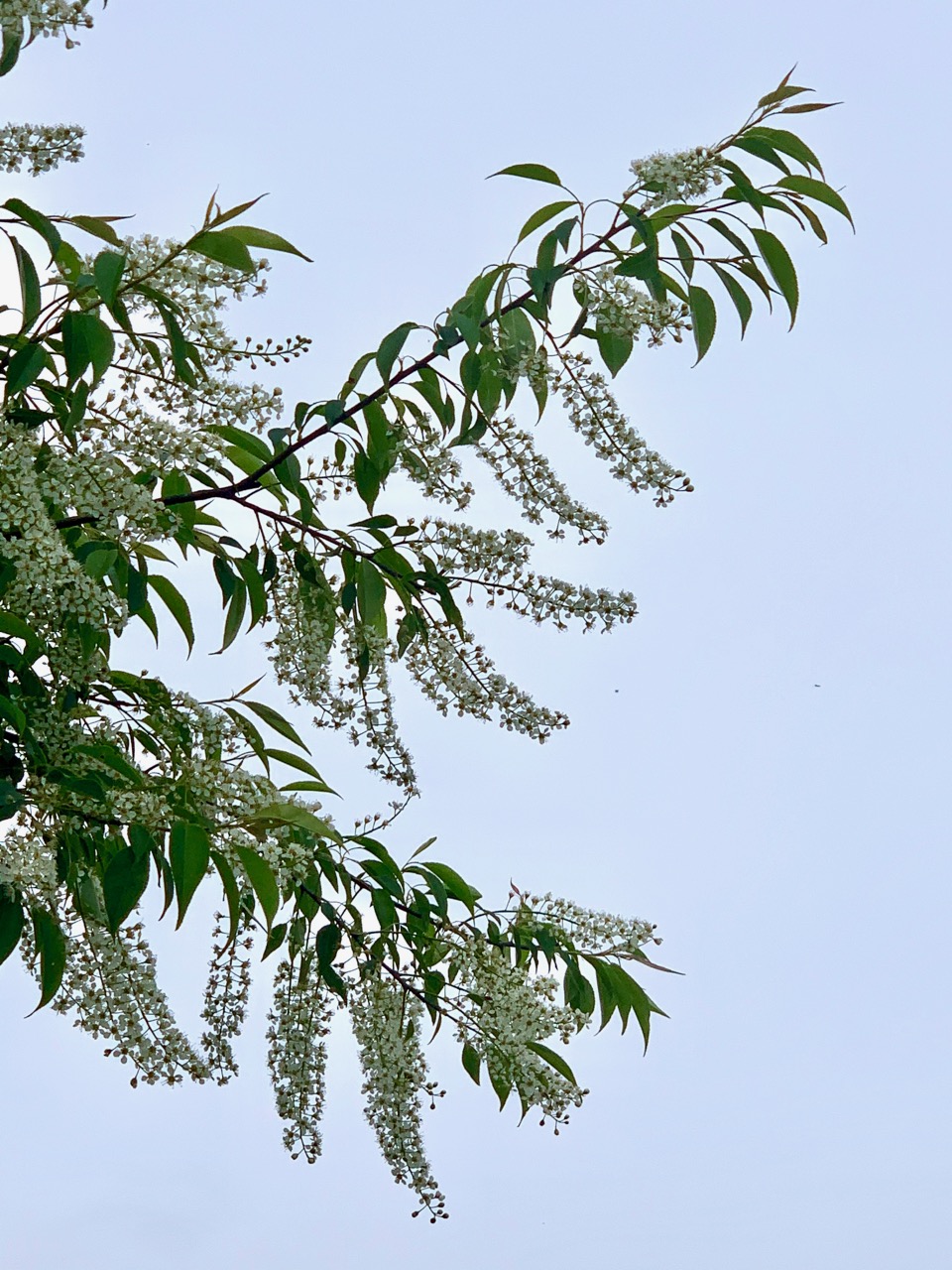
We've seen the pussy willow and viburnum bloom, followed by the magnolia, the service berry, wild cherry, crabapple, peach and apple trees. We peer down at the mayapples unfurling their umbrella leaves and discover morel mushrooms pushing up from leaf debris on the forest floor.


We've watched as the bluebirds and tree swallows have taken up residence in our bird boxes and the red-wing blackbirds, robins and brown thrashers have built exquisite nests and hatched their chicks. Nearly everyday we spy the dreamsicle-colored orioles feeding from the hickory blossoms. They even showed up on our back porch earlier this week.


In our big garden, I've planted fava beans, peas, onions, beets, chard and shallots. This week, I'll add pumpkins, squashes, cucumbers and tomatoes to the mix. In my herb garden, the mint and lemon balm, the lavender and the sage, the rue and tarragon are all spreading tuffs of green. The bees have found the nectar in the bee garden, drinking freely from the blue blossoms of wild indigo and eastern bluestar.

Because we were here and paying attention, we saw the praying mantis cases release hundreds of baby mantises. Seems like every time I'm out and about, I see an interesting bug to photograph to send to Hazel (as part of my ongoing mission to help her love bugs).


While new life bursts forth on every square inch of Farm Dover, heartache comes with it. Just outside our study window, robin eggs are smashed in their nest by an unknown predator, hungry rabbits chew down to the quick the coreopsis in the back garden, kale plants are uprooted and absconded in the big garden, and cruelest of all, a May freeze turns the buds crisp and black on the big-leaf and cucumber magnolias, hickory trees, sassafras and tulip trees -- and most tragically, the pawpaw flowers.


When I am saddened by the current state of the world, I go for a ramble along our patchwork of paths. Walking these green pathways is my balm; it heals my soul and replaces my despair with hope. Paying attention to the miraculous unfolding of the seasons, cures my wounded soul.


When the children were young, we rotated who said the blessing before dinner. Mary, our youngest and fiercest, would always include a blessing for "anyone sick or not well." Jack would challenge the sense of that category, arguing that it was redundant. Mary would adamantly explain that it was possible to be unwell, even if you were not sick. That's how I think about these days. I ask blessings on all who are sick or not well. May we all be healed.


Tuesday, April 21, 2020

We are only visitors

Knowing that you love the earth changes you, activates you to defend and protect and celebrate. 
But when you feel that the earth loves you in return, that feeling transforms the relationship
from 
a one-way street into a sacred bond.
– Robin Wall Kimmerer


Fifty years ago tomorrow marks the first Earth Day. It was organized as a teach-in on college campuses by Gaylord Nelson, a junior senator from Wisconsin, who had long been concerned about the deteriorating environment in the United States. Today, it is the largest secular observance in the world, marked by more than a billion people committing to a day of action to change human behavior and create policy changes. Well, at least that was the case before a pandemic swept over the earth...


Since we are sheltering in place, I will spend Earth Day 2020 much as I've spent every day of the last six weeks. I'll rise and go for a walk along the paths. I may collect some edibles along the way. I'll probably toil in the garden until Ed finds me to go out into the fields and woods, hunting down and destroying invasive plants. Later, we might stop at some of the 1000+ trees that we've planted to clear the weeds from their bases, fertilize and mulch them. We might divide some perennials in the Bee Garden, or add a new layer of wood chips to tamp down the weeds. The grass needs mowing and the fences need weed whipping. The list, as always, is unending.


Ed and I have been grateful to have this work this spring. Our days pass quickly; we fall into bed well before 10 p.m. with a duel sense of achievement and exhaustion.

We are the caretakers of this patch of land; we understand that we do not own it. Sure, we possess a legal piece of paper that says it is ours, but we know...we are only visitors.

The Moment
The moment when, after many years
of hard work and a long voyage
you stand in the centre of your room,
house, half-acre, square mile, island, country,
knowing at last how you got there,
and say, I own this,

is the same moment when the trees unloose
their soft arms from around you,
the birds take back their language,
the cliffs fissure and collapse,
the air moves back from you like a wave
and you can't breathe.

No, they whisper. You own nothing.
You were a visitor, time after time
climbing the hill, planting the flag, proclaiming.
We never belonged to you.
You never found us.
It was always the other way round.

Thursday, February 13, 2020

A forest in my pocket

When I thrust my hands into the pockets of my farm jacket, vest or overalls, I'm bound to turn up a handful of acorns, gathered from oaks scattered about Farm Dover. Seems I carry a whole forest around with me.


I also manage to scavenge acorns from our travels; and some come from magnificent oaks I see around town, especially those at Second Presbyterian or Cave Hill Cemetery. My favorite source is an incredible tree in the Indian Hills front yard of my friend Jody.


Eventually I get around to depositing my treasures in a baggie of moist dirt that I keep in the fruit-and-vegetable drawer of the fridge. After a couple of months of cold stratification, an embryonic root will appear on some of the acorns and I'll know it is time; I sort the nuts and plant them in tiny pots, prop them near the front window in our study, water them every Sunday morning, and impatiently wait to see them poke up their tiny sprouts.


Eventually, Ed and I plant these tiny oaks along our trails, protecting them from deer, bunnies and weeds with a chicken-wire cage surrounded by a ring of mulch. Then, we take great pride in watching them grow.
_____________________

I've always had a thing for acorns. In fact, in my previous life, the logo for my marketing company was a stylized acorn/monogram G. (I somehow equated tiny acorns with good marketing ideas and mighty oaks with successful organizations).


In my life at Farm Dover, this transformation from tiny acorns to magnificent oaks takes on a whole new level of wonder and obsession. As I roll these beautiful nuts around in my hands, I ponder the miracle of having one's destiny within. It was Aristotle who first described this purpose of existence, an internal code which turns potential into reality. It is in the entelechy of a caterpillar to become a butterfly; within the acorn lies the oak.


Not all the seeds that I plant are oaks – some are pawpaw, chestnut or buckeye, a few are hickory. Of all the trees we have planted from seeds or seedlings (over 1000), perhaps 40 percent are oaks. Of all the species that we could chose, oaks sequester the most carbon and support the greatest number of butterflies and moths, 534 to be exact (according to Douglas Tallamy, University of Delaware professor of entomology). And, if you consider the number of species around Farm Dover that depend on acorns for food: deer, raccoons, turkey, mice, squirrels, – plus, the dozens of species of birds that depend on the canopy and cavities for nesting sites, you can begin to appreciate all they offer – truly, they are quintessential giving trees. 


Last week I finished reading "The Overstory," last year's winner of the Pulitzer Prize in Fiction. It was as if Richard Powers wrote this book just for me. I've not stopped thinking about it since I turned the last of its 500+ pages. While the epic is told through nine characters, it is the old trees that are the real protagonists of the story. They are the ones with the real wisdom -- and the ones we must learn to listen to. I'm trying.

There is a folksong written by Malvina Reynold in 1974 that goes something like: If you love me, plant me a rose. If you love, love, me, plant me an apple tree. I venture to say that if you really love me -- or this fragile planet we call home – plant me an oak tree. Now that's true love.